

For families who didn’t grow up with the concept, “boarding school” can sound like something out of a novel — dormitories, strict schedules, homesickness. In reality, modern boarding schools look very different, and for thousands of international families every year, boarding is what makes an outstanding education abroad possible in the first place. So what is a boarding school, exactly? If you’re weighing up the option for the first time, here’s what boarding school actually means, what day-to-day life looks like, and what to consider before choosing one.
Key Learnings
- Boarding school means living on campus during term time, in addition to attending classes there — it’s a way of living, not a separate curriculum.
- Families choose boarding for academic structure, independence, international exposure and consistent pastoral care, especially useful for relocating expat families.
- A typical boarding day balances lessons, sport or activities, supervised study time and communal meals, with staff on hand outside class hours.
- The main difference between boarding and day school isn’t the lessons — it’s the structure and support around them.
- When comparing boarding schools, look at the curriculum offered, pastoral care structure, community size, extracurricular life and location.
- Switzerland is a popular boarding destination for its safety, central European location and multilingual environment.
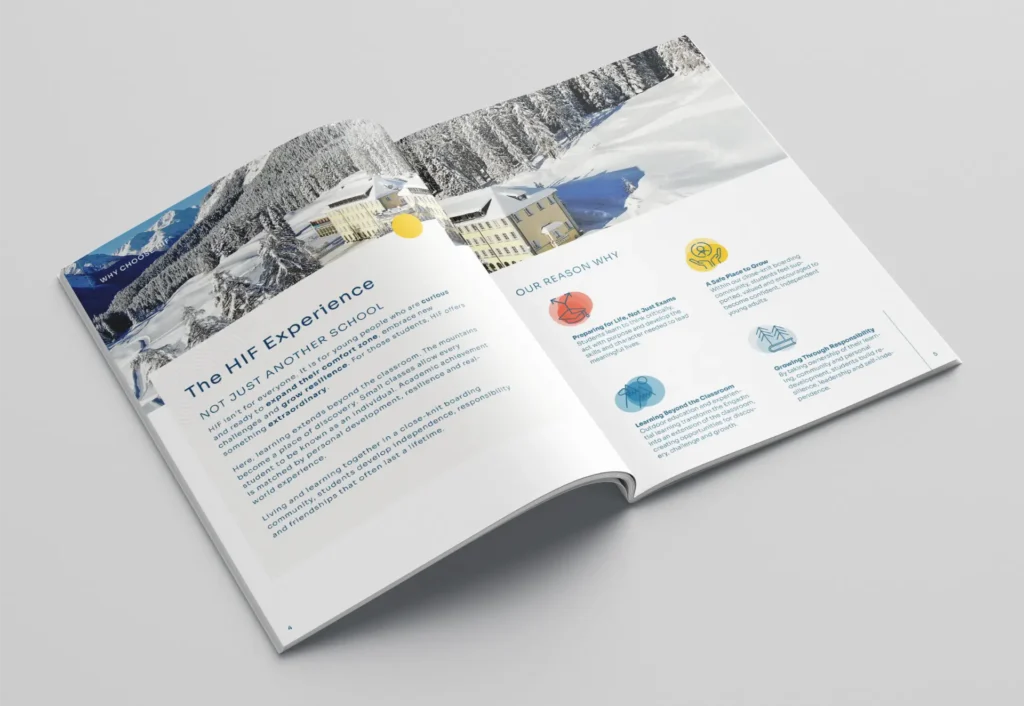
- HIF is a boarding school in the Swiss Alps offering the English National Curriculum (iGCSE & A-Levels) and Swiss Matura, with small classes and a close-knit boarding community.
What Is a Boarding School? The Basic Definition
At its simplest, a boarding school is a school where students live on campus during term time, in addition to attending classes there. Instead of going home at 3pm, boarding students eat, study, socialise and sleep at the school, usually returning home during official holidays and, depending on the school, some weekends. Most boarding schools also welcome day students who live locally and go home each evening, so a single school can serve both boarding and day families side by side.
Boarding isn’t a separate curriculum or qualification — it’s a way of living and learning. A boarding school still follows a specific academic programme (in HIF’s case, the English National Curriculum, leading to iGCSEs and A-Levels, alongside the Swiss Matura); boarding simply describes where and how students experience that programme outside of lesson time.
Why Do Families Choose Boarding?
Every family’s reasons are different, but a few come up again and again:
- Structure and focus — Academic focus. Without a daily commute and with structured study time built into the evening, students often find it easier to stay on top of schoolwork.
- Independence and international exposure — Living alongside peers from different countries and backgrounds builds independence and cultural fluency that’s hard to replicate at a day school.
- Pastoral care — Boarding staff are on hand outside of lesson time to support students’ wellbeing, not just their academics.
- Stability during relocation — For expat families who relocate for work, boarding offers school continuity even if the family moves again.
Boarding School vs. Day School: The Key Difference
The academic content taught can be identical between a boarding and a day school offering the same curriculum. The difference is in everything around it: a boarding student has structured evening study time built in, eats meals as part of a school community rather than at home, and has staff available outside of classroom hours for both academic and personal support. For many international families, that consistency matters more than any single lesson.
What to Look for When Choosing a Boarding School
- Curriculum — What academic programme does the school follow, and where does it lead? (iGCSEs and A-Levels, the IB, a national curriculum, or a combination.)
- Pastoral care — How is pastoral care structured? Who is responsible for a student’s wellbeing outside of class?
- Community size — A smaller boarding community often means students are known individually by staff, rather than being one of hundreds.
- Extracurricular life — Sport, outdoor education and clubs are a major part of boarding life — look for a school where these feel like a real part of the offering, not an afterthought.
- Location — Where is the school, and what does the surrounding environment offer in terms of safety and quality of life?
Boarding School in Switzerland: Why the Alps Are a Popular Choice
Switzerland has long been a destination for international boarding education, and for practical reasons as much as scenic ones: political stability, a strong safety record, a central location for travel across Europe, and a genuinely multilingual culture that reinforces what students are already learning in the classroom.
At Hochalpines Institut Ftan (HIF), that setting is the village of Ftan in the Swiss Alps, in the canton of Graubünden. Students follow the English National Curriculum — iGCSEs and A-Levels — or the Swiss Matura, in small classes where, as the school puts it, “every student is known as an individual.” Boarding life is built around a close-knit community, with outdoor education and sport, including a dedicated Sports Academy, woven into everyday school life rather than treated as an add-on.
If you’re exploring whether boarding is the right fit for your family, the best next step is usually to see it for yourself. Find out more about life in our boarding community, or get in touch with our Admissions team to arrange a visit.