

If you’re exploring schools abroad, you’ve probably noticed the same two terms everywhere: “international school” and “British school.” At first glance, they might seem worlds apart, but in reality, the two often overlap in ways that surprise many families. Let’s look at international school vs British school: Two Labels, Not Always Two Different Things.
A “British school” abroad usually follows the framework of the National curriculum for England, most commonly leading to iGCSEs at age 16, and A-Levels at age 18.
“International school” is a broader, less precise term describing a school with:
- An international student body
- Curricula such as the International Baccalaureate (IB), an American curriculum, a blended approach, or a contextualised version of the British curriculum. In other words, a school can be both British in curriculum and international in environment and outlook. The combination is more common than the either/or framing suggests, and it’s often exactly what families relocating abroad are looking for.
Curriculum: What Are Students Actually Studying?
Schools following the British curriculum typically offer iGCSEs between the ages of 14 and 16 across a broad range of subjects, before narrowing to three or four subjects at A-Level between the ages of 16 and 18. A-Levels are recognised by universities worldwide, not just in the UK, and are respected for the depth of subject knowledge they demand.
Schools describing themselves primarily as “international” may offer the IB Diploma – which focuses on a broader spread of subjects right through to age 18 – or a hybrid international qualification designed to sit alongside a national curriculum. Neither approach is objectively “better”; both suit different learning styles and future university plans.
Culture and Community
This is often where the real difference lies, more than in the terminology. A school with strong British traditions may have a house system and uphold academic rigour. A school that leads with “international” in its identity tends to promote its multicultural student body, multiple languages spoken on campus, and a curriculum designed to feel equally relevant to families from any country.
University Pathways
Both routes lead to strong outcomes, so families don’t need to focus on choosing an international school vs British school. A-Levels are accepted by UK universities and by universities in the US, Canada, Australia, and beyond. The IB is also held in high regard and accepted worldwide. The right pathway depends more on how individual students learn – deep specialisation or a broad subject spread – than on which university system a family is aiming for.
So Which One Is Right for Your Child?
Ask what actually matters to your family: Is it the academic rigour and subject depth of a specific curriculum? Or is it the makeup of the community your child will spend their teenage years in, and how international, diverse, and far from home it feels? For many families, the honest answer is that they want both: the recognised academic pathway of a British curriculum, delivered inside a genuinely international community.
International School vs British School: Where HIF Fits In
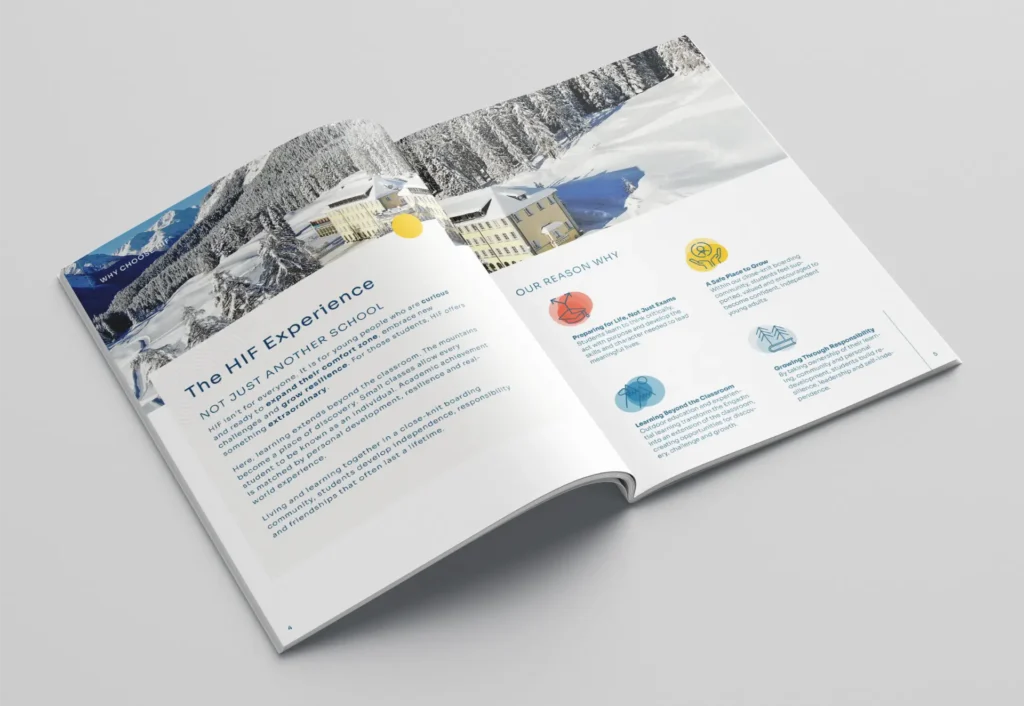
At Hochalpines Institut Ftan (HIF), students follow the National curriculum for England, culminating in iGCSEs and A-Levels, while studying and boarding in the Swiss Alps alongside classmates from a wide range of nationalities. When it comes to international school vs British school, HIF is a deliberate combination of both: we have the academic structure and university recognition of British education, inside a school community that is international by design, not by accident. If you’re weighing up “international” against “British,” it’s worth asking schools directly how they combine the two, because increasingly, the best ones do.
Key Learnings
- “British school” usually means a school following the National curriculum for England (iGCSEs and A-Levels); “international school” is a broader term covering many possible curricula, including the IB.
- A school can be both British in curriculum and international in community, and this combination is common, not contradictory.
- A-Levels are recognised by universities worldwide, not only in the UK; the IB is similarly globally recognised.
- The practical difference families notice is often cultural (community, languages, traditions) more than academic.
- The right choice depends on whether a family prioritises subject depth and a specific academic tradition, or curriculum breadth and student-body diversity, or, as with many schools, both at once.
- HIF follows the National curriculum for England (iGCSE and A-Levels) within a genuinely international, multilingual boarding community in Switzerland.